Document structure
View explanations
Referenced documents
Document Highlights
Consolidated publications
 Return back
 | Ordinance No 03 of 26 March 2026 of the Chairman of the Governing Board of the Legal Entity under Public Law called the Pension Fund of Georgia | |
|---|---|
| Document number | 03 |
| Document issuer | სსიპ – საქართველოს საპენსიო ფონდის მმართველობითი საბჭოს თავმჯდომარე |
| Date of issuing | 26/03/2026 |
| Document type | სსიპ – საქართველოს საპენსიო ფონდის მმართველობითი საბჭოს თავმჯდომარის დადგენილება |
| Source and date of publishing | Website, 27/03/2026 |
| Registration code | 040030000.85.099.016003 |
| Consolidated publications | |
Initial version (27/03/2026 - 01/07/2026)
Ordinance No 03
of 26 March 2026
of the Chairman of the Governing Board of the Legal Entity under Public Law called the Pension Fund of Georgia
Tbilisi
On the Approval of the Statute of the Legal Entity under Public Law called the Pension Fund of Georgia
On the basis of Article 4(4), Article 9(10)(a) and Article 9(11) of the Law of Georgia on Funded Pension, Article 25(1)(b) of the Organic Law of Georgia on Normative Acts and the minutes of the meeting No 27 of 24 February 2026 of the Governing Board, the Governing Board shall establish:
Article 1
1.The attached Statute of the Legal Entity under Public Law called the Pension Fund and Annex No 1 shall be approved.
2. Upon the entry into force of this Ordinance, the Ordinance No 01 of 1 May 2025 of the Chairman of the Governing Board of the Legal Entity under Public Law called the Pension Fund of Georgia on the Approval of the Statute of the Legal Entity under Public Law called the Pension Fund of Georgia shall be declared invalidated.
Article 2
This Ordinance shall enter into force upon its promulgation.
Chairman of the Grigori Morchiladze
Governing Board of the
LEPL Pension Fund
The Statute of the Legal Entity under Public Law called The Pension Fund of Georgia
Chapter One
General Provisions
Article 1 – General provisions
1. This Statute shall determine the basic principles of organisation and activities of the Legal Entity under Public Law called the Pension Fund of Georgia (the Pension Fund).
2. The Pension Fund is an independent legal entity under public law established on the basis of the Law of Georgia on Funded Pension (the Law), which is responsible for the implementation, management and administration of the funded pension scheme.
3. The Pension Fund is independent in carrying out its activities, functions and competence, including in relation to organisation, administration and budget.
4. The Governing Board of the Pension Fund (the Governing Board) is the highest governing body of the Pension Fund.
5. The National Bank of Georgia (the National Bank) shall regulate and supervise the activities of the Pension Fund in accordance with the Law and other legal acts.
6. To achieve the set goals and fulfil the assigned functions, the Pension Fund shall, on its behalf, acquire rights and duties, enter into agreements, and appear before a court as a plaintiff or a defendant.
7. Terms used in this Statute shall be defined in accordance with the Law if not otherwise established by this Statute. For the purposes of this Statute, the terms used herein shall have the following meanings:
a) regulatory rule – rule regulating activities of the Legal Entity under Public Law called the Pension Fund of Georgia approved by the Order No 51/04 of 28 February 2025 of the President of the National Bank of Georgia;
b) legislation regulating the Pension Fund – the Law and the subordinate normative acts issued by the National Bank and the Pension Fund on their basis;
c) bonus - a type of financial incentive for the executive directors, their deputies and other employees of the Pension Fund, which includes rewards, increments and other measures of incentive;
d) unified bonus package – relevant amounts of bonuses approved by the Governing Board for the executive directors, their deputies and other employees of the Pension Fund;
e) remuneration policy document – a document prepared by the Remuneration and Nomination Committee, which includes principles for developing key performance indicators, their periodicity and evaluation procedure, key principles and rules for developing bonus packages, as well as measures aiming at avoiding conflict of interests;
f) staff policy document - a document prepared by the Remuneration and Nomination Committee, which is approved by the Chairman of the Governing Board in the form of a decree on the basis of the minutes of the relevant meeting of the Governing Board , and which includes the procedure for setting up the Competition Commission and its activities, the criteria and procedures for selecting the candidates and their evaluation, the procedures for promoting the employees or their transfer to another position, the procedure for the employment and the appointment of employees, the process of evaluation of executive directors, their deputies and the employees, the systems of motivation and career advancement, as well as other issues regulating labour relations.
Article 2 – Functions of the Pension Fund
1. The Pension Fund shall manage pension assets as a fiduciary, in the interests of participants, pension recipients and their successors. The main purpose of the Pension Fund shall be the implementation, administration and management of the funded pension scheme in accordance with the Law and the legislation of Georgia. The main functions of the Pension Fund shall be:
a) management and administration of the funded pension scheme, ensuring its proper functioning;
b) the investment of pension assets in accordance with the legislation regulating the Pension Fund, as well as in accordance with good investment principles and in the interests of participants of the funded pension scheme, pension recipients and their successors;
c) the analysis and risk assessment of the funded pension scheme, the formation of the view relating to the development and improvement of the funded pension scheme;
d) the registration of employees and self-employed persons who have become members of the funded pension scheme through the electronic system for the administration of pension contributions and the creation of individual retirement accounts in the electronic system for the administration of pension contributions for every participant;
e) the opening of accounts at the National Bank, commercial banks and/or other financial institution(s) and the management of pension assets, including the monetary resources available at the nominee accounts of the Pension Fund, in accordance with the interests of the participants of the funded pension scheme, pension recipients and their successors;
f) the management and administration of the electronic system for the administration of pension contributions, including through a third party;
g) the management of the funded pension scheme and the drafting and adoption of legal acts required for its administration, including the drafting and adoption of legal acts related to paying pension contributions, forms for submitting information, and administration of funds paid in excess;
h) the carrying out of measures related to pension contributions, including the issues related to the violation of the obligation to make a pension contribution;
i) the conclusion of agreements:
i.a) with an asset management company (companies), a specialised depositary and a person (persons) providing any service for carrying out investment activities or administrative activities and/or supplying goods;
i.b) with a person (persons) rendering accounting, audit, legal or actuarial services and other services necessary for the Pension Fund;
i.c) on the purchase and disposal of the immovable or movable property (including equipment or software) necessary for the activities of the Pension Fund;
j) the request and reception of information regarding any transaction carried out on behalf of the Pension Fund from an asset management company (companies), a specialised depositary and/or persons rendering other services;
k) the administration of the process of payment of pensions and pension assets to the participants and, in the case defined by the Law, to the successors of the participants;
l) the staffing of the Pension Fund with highly qualified employees and the establishment of competitive remuneration and working conditions for them;
m) the preparation and execution of the annual budget of the Pension Fund;
n) the preparation of the investment policy of the Pension Fund and the investment of pension assets;
o) the provision of the process of internal audit of the Pension Fund;
p) the preparation of the risk management framework of the Pension Fund which shall take into account both the internal and external factors of the organisation;
q) reporting before the participants, the National Bank of Georgia and the Parliament of Georgia.
r) carrying out measures provided for by the legislation regulating the Pension Fund against a person that has violated the obligation to make a pension contribution;
s) carrying out other relevant activities provided for by the Law and the legislation of Georgia.
Article 3 – Governing bodies of the Pension Fund and its structure
1. The Pension Fund shall exercise its powers:
a) through the Governing Board;
b) through the executive body of the Pension Fund which shall include:
b.a) the Director General of the Pension Fund;
b.b) the Chief Investment Officer;
b.c) the Chief Risk Officer;
b.d) the Head of the Internal Audit;
b.e) other executive director(s) appointed by the Governing Board, if any;
c) through the relevant committees.
2. The organisational structure of the Pension Fund shall consist of the following structural units:
a) the Investment Office;
b) the Risk Management Office;
c) the Internal Audit Department;
d) the Finance Department;
e) the Administrative Department;
f) the Information Technology Department;
g) the Department of Operations and Award and Payment of Pensions;
h) the Monitoring and Execution Department;
i) the Department of Human Resources Management;
j) the Strategic Communications Department;
k) the Legal Department;
l) Claims Review Office.
3. The Pension Fund shall carry out its functions through the structural units, offices and departments, provided for by this Statute. The structural units may be divided into divisions to properly and efficiently perform the assigned functions.
4. The Director General of the Pension Fund (the Director General) shall, in accordance with this Statute, draft statutes and structure of structural units provided for by this article and submit them for agreement to the Governing Board. The functions and duties of the structural units and their employees shall be determined in the job description of every employee approved by the Director General.
Article 4 – The Governing Board
1. The Governing Board shall be composed of 9 (nine) members, three of which shall be appointed in accordance with Article 9(4) of the Law, five – in accordance with Article 9(5) of the Law, and one member shall be appointed by virtue of the position.
2. The Governing Board shall elect the Chairman of the Governing Board and his/her Deputy in accordance with the procedure determined by Article 5(6) of this Statute. When electing a Chairman of the Governing Board and his/her Deputy, it shall be inadmissible for a member of the Governing Board to vote for oneself.
3. The following persons cannot be a Chairman of the Governing Board or his/her Deputy:
a) the ex officio member of the Governing Board;
b) a member of the Governing Board, if he/she is the executive director of the Pension Fund at the same time.
4. The term of office of the Chairman of the Governing Board and his/her deputy cannot exceed their remaining term as members of the Board.
5. A member of the Governing Board may be re-elected as the Chairman of the Governing Board and the Deputy Chairman only if his/her total term of office does not exceed 6 (six) years.
6. The Governing Board shall conduct meetings in compliance with the legislation regulating the Pension Fund.
7. The Director General who is not a member of the Governing Board at the same time, shall attend all meetings of the Governing Board, except for an extraordinary meeting. The issue of attendance of the Director General on an extraordinary meeting shall be decided by the Governing Board in each specific case. The Director General shall attend the meetings of the Governing Board without the right to vote, except for the cases when the Director General represents a member of the Governing Board, in which case he/she shall vote only as a member of the Governing Board.
8. The Head of Legal Department shall attend all meetings of the Governing Board, except for extraordinary meetings, without the right to vote and perform the function of a secretary of the meeting of the Governing Board. The issue of attendance of the Head of Legal Department on an extraordinary meeting shall be decided by the Governing Board in each specific case. The Director General and a secretary of the meeting shall prepare the agenda of the meeting of the Governing Board in agreement with the Chairman of the Governing Board. The secretary of the meeting shall draw up the minutes of the meeting and hand them for signing to the members of the Governing Board; after that he/she shall transfer the minutes to a relevant structural unit for storage. If the meeting of the Governing Board is conducted without the Head of the Legal Department, the Governing Board shall appoint a secretary of the meeting from the members of the Governing Board.
9. Other employees of the Pension Fund, as well as other invited persons, may attend the meeting of the Governing Board on the basis of the request of the Chairman of the Governing Board or at least two members of the Governing Board made reasonably in advance.
Article 5 – Procedure for holding a meeting of the Governing Board
1. Meetings of the Governing Board shall be held as appropriate, but no less than once a quarter. A meeting of the Governing Board may be held by using the means of electronic communication. At the end of each year, the Governing Board shall establish a calendar of meetings for the next year.
2. Where appropriate, the Chairman of the Governing Board alone, or at least 3 (three) members of the Governing Board shall be authorised to convene, without applying to the Chairman, an extraordinary meeting of the Governing Board. The Director General or at least two executive directors together shall be authorised to request convening an extraordinary meeting of the Governing Board by submitting the relevant request and agenda suggested thereof to the Chairman of the Governing Board.
3. The meetings of the Governing Board shall be convened and chaired by the Chairman of the Governing Board. In his/her absence, the duties of the Chairman of the Governing Board shall be performed by the Deputy Chairman of the Governing Board. In the absence of the Chairman or the Deputy Chairman of the Governing Board, the Chairman of the Governing Board shall be authorised to determine a one-time chairman of the meeting from the members of the Governing Board before the meeting of the Governing Board is conducted.
4. The secretary of the meeting shall notify every member of the Governing Board and other persons invited to the meeting (if any) of the venue and agenda of the meeting and provide them with the relevant materials at least 5 (five) working days before the date of the meeting. The meeting may be attended via the means of electronic communication.
5. Before each meeting of the Governing Board starts, it shall be necessary to have a relevant quorum required for making a decision. The Governing Board is authorised to adopt decisions if at least 6 (six) members of the Governing Board with a right to vote attend the meeting of the Governing Board.
6. Each member of the Governing Board shall have 1 (one) vote and may not transfer his/her own voting right to another person. The Governing Board shall be authorised to adopt decisions with the vote of no less than 6 (six) members of the Governing Board. In the case of equal votes, the vote of the Chairman of the Governing Board, and in his/her absence, the chairman of the meeting, shall be decisive.
7. The working process of the meeting of the Governing Board and decisions made at the meeting shall be documented in the form of minutes by the secretary of the meeting. It shall be signed by the Chairman of the Governing Board, and in his/her absence, the chairman of the meeting and the attending members of the Governing Board.
8. The decisions regarding the investment policy document, risk management framework and the remuneration policy shall be made by the Governing Board on a meeting held by physical attendance. The meeting of the Governing Board regarding any other issue may take place through the following means of electronic communication:
a) a teleconference, in compliance with the quorum provided for by this article; or
b) by the Chairman of the Governing Board or the Director General sending, in writing, the issue to each member of the Governing Board, in which case each member of the Governing Board shall notify his/her position on the issue (vote) in writing to the Chairman of the Governing Board or the Director General in compliance with a quorum provided for by this article.
9. The non-appearance of a member on the meeting of the Governing Board caused by specific objective circumstances, rendering his/her attendance on the meeting impossible due to reasons beyond his/her control, shall be considered as good reason. If the existence of a good reason is known in advance, it shall be notified (possibly, electronically) to the Chairman of the Governing Board at the earliest opportunity but not later than 48 hours before holding the meeting of the Governing Board. The Governing Board shall be authorised, in each specific case, to establish on the relevant meeting whether the reason is good enough. In case a member of the Governing Board is absent on the meeting of the Board three times consecutively without good reason, measures provided for by the Law shall be taken.
Article 6 – Functions of the Governing Board
The functions of the Governing Board shall be as follows:
a) by the end of each calendar year, to approve the annual budget and the staff list of the Pension Fund for the next calendar year;
b) to approve the statutes of the committees of the Pension Fund and to agree on the statute and structure of each structural unit of the Pension Fund;
c) to supervise the activities of the Pension Fund and its executive directors, and to provide relevant instructions to them;
d) to select, through competition, appoint, and dismiss the Director General, the Chief Investment Officer, the Chief Risk Officer and the Head of the Internal Audit;
e) to agree on the normative acts to be issued by the Director General;
f) to carry out an independent financial audit of the Pension Fund;
g) to review and approve the investment policy document, the risk management framework, the remuneration policy document and other documents, as provided for by the legislation regulating the Pension Fund;
h) to prepare and approve the framework for the management of conflict of interests and other documents provided for by the legislation regulating the Pension Fund;
i) if necessary and with the periodicity determined by the legislation regulating the Pension Fund, to revise an investment policy document, including the Strategic Asset Allocation (SAA), and update them accordingly;
j) to monitor and assess all activities related to the investment of pension assets at least once a quarter;
k) upon the recommendation of the Investment Committee, to select a specialised depositary and asset management company (companies);
l) to supervise and monitor the activities of the relevant structural units carrying out the function of risk management of the Pension Fund;
m) to ensure compliance of the activities of the Pension Fund with the legislation regulating the Pension Fund;
n) to prepare and approve the outsourcing policy for the activities of the Pension Fund;
o) to request the submission of a report from the committees, executive directors and/or any employee of the Pension Fund on the issues determined by the Governing Board;
p) to approve the unified bonus package for the executive directors and their deputies and all other employees of the Pension Fund;
q) to send the necessary external correspondence by the Chairman of the Governing Board in order to exercise the authority of the Governing Board;
r) to exercise other powers determined by the legislation.
Article 7 – Committees of the Pension Fund
1. The Governing Board shall establish the following standing committees: Audit Committee, Risk Committee, Investment Committee and Remuneration and Nomination Committee. Each committee shall have its statute, a chairman, and a deputy chairman. These committees shall be staffed in accordance with the legislation regulating the Pension Fund.
2. The Investment Committee shall develop an investment policy document and the procedures for its implementation, and submit them to the Governing Board for approval, as well as select an asset management company/companies and a specialised depositary in compliance with the criteria established by the Governing Board. The Investment Committee shall make decisions regarding the issues related to investment activities in accordance with the investment policy document.
3. The Risk Committee shall prepare a risk management framework and the procedures for its implementation, and submit them to the Governing Board for approval. The Risk Committee shall make decisions regarding the issues related to risk management in accordance with the risk management framework.
4. Unless otherwise determined by the Audit Committee for a particular meeting, the Head of the Internal Audit shall attend all meetings of the Audit Committee. The Head of the Internal Audit shall not be authorised to participate in the decision-making of the Audit Committee at the meetings. The Audit Committee shall be authorised to supervise all the activities of the Pension Fund, including review and supervise the issues related to financial reporting, risk management, internal control system, internal audit activities and audit services of the Pension Fund, and also, in accordance with the legislation of Georgia, select an audit firm for carrying out external audit, and nominate it to the Governing Board for appointment. The audit firm shall be selected from the 4 (four) major audit firms in the world. The Audit Committee shall establish and submit to the Director General for approval the procedures for all operations related to the transfers, bank operations and payment instruments of the Pension Fund in accordance with the applicable legislation, except for the issues provided for by the legislation regulating the Pension Fund.
5. The Remuneration and Nomination Committee shall prepare a remuneration policy document and a staff policy document in accordance with the legislation regulating the Pension Fund and submit it to the Governing Board for approval.
6. The Remuneration and Nomination Committee shall carry out the process of evaluation of the employees of the Pension Fund, including the executive directors and their deputies, on the basis of the remuneration policy document, and as a result, submit to the Governing Board a unified bonus package for approval. The process of evaluation of the employees of the Pension Fund (except for the executive directors and their deputies) shall be carried out with the involvement of the heads of the relevant structural units.
7. In order to determine the amount of bonuses for executive directors and their deputies, the Remuneration and Nomination Committee shall request information from the relevant Committees, after which the Remuneration and Nomination Committee shall consolidate and process such information.
8. The unified bonus package shall be based on the key performance indicators, the principle of the calculation of which shall be determined by the remuneration policy document. The Remuneration and Nomination Committee shall determine the key performance indicators and submit them to the Governing Board for approval.
9. Each committee shall prepare their statutes, which shall determine the mandate of that committee, its area of activities and the procedures which, inter alia, include the information on the regular reporting of the committee to the Governing Board, its cooperation with other committees, the restrictions relating to the membership of the committee and the functions of the members of the committee. The statute of the committee shall be approved by the Governing Board.
10. The activities carried out by the members of the Governing Board, the executive directors, or other employees of the Pension Fund shall not be remunerated.
11. The committees may include the members of the Governing Board (except for the ex officio member), executive directors, the employees of the Pension Fund or the invited experts, except for the Audit Committee. The members of the committee shall be appointed by the Governing Board. In the process of making decisions by the committees, the members of the Governing Board and the executive directors shall have the voting right where the respective executive director is a member of a committee, except for the Audit Committee. A chairman of the committee and his/her deputy shall be selected from the members of the committee. Each committee shall have a secretary, who is appointed by the respective committee.
12. The Chairman of the Governing Board and the Deputy Chairman of the Governing Board may be the members of the committee, but they cannot be chairmen and deputy chairmen of a committee at the same time.
13. A committee meeting shall be authorised to adopt decisions if at least two-thirds of the members of the committee are present. Decisions at the committee shall be made by a majority of votes of its members present at the meeting. In the case of equal votes, the vote of the chairman of the committee, or in his/her absence, the vote of the deputy chairman, shall be decisive.
14. Committee meetings may be held and decisions may be made through physical meetings and also by means of electronic communication:
a) by means of a teleconference, in compliance with the quorum determined in this article; or
b) by sending, in writing, the issue to each member of the committee by the chairman of the committee, in which case each member of the committee shall notify his/her position on the issue (vote) in writing to the chairman of the committee in compliance with a quorum determined in this article.
15. Unless otherwise determined for a specific committee meeting, the Chief Investment Officer shall attend all meetings of the Investment Committee.
16. Unless otherwise determined for a respective meeting of the Committee, the Chief Risk Officer shall attend all meetings of the Risk Committee.
17. Unless otherwise determined by the respective committee for a specific committee meeting, the Director General shall attend all meetings of the respective committee.
18. The Governing Board shall be authorised to establish other additional committees and determine their composition.
19. Each committee shall be obliged to submit a report on its activities to the Governing Board upon its request, at least once a year.
20. The Governing Board shall be authorised to establish special temporary committees to work on specific issues that require targeted expert examination, enhanced supervision, or the management of possible conflicts of interests. Conclusions made as a result of the work of such committees shall be recommendatory and the right to make final decisions regarding such issues shall rest with the Governing Board, unless otherwise determined in advance by the National Bank.
Article 8 – Advisory group and working group
1. In order to produce recommendations, the Governing Board shall be authorised to set up and invite an advisory group, which shall consist of the representatives of employees and employers. If requested by the National Bank, the Governing Board shall be obliged to comply with the request of the National Bank regarding the setting up of an advisory group. The procedure for the selection and operation of an advisory group shall be determined by the Governing Board.
2. An advisory group shall consist of at least 6 (six) members, who shall be nominated by major employers’ and employees’ unions/associations on the basis of the request of the Director General. A relevant field expert may also be invited as a member of the advisory group.
3. Recommendations of the advisory group shall be reviewed by the Governing Board on the following meeting after receiving the recommendations from the advisory group.
4. The Governing Board or each committee shall be authorised to set up a working group from its members, executive directors and other employees of the Pension Fund, which shall support the performance of the functions of the Governing Board or the relevant committee. The working group may not make decisions independently.
Article 9 – Procedure for the selection of executive directors of the Pension Fund and their deputies
1. The Governing Board shall select executive directors of the Pension Fund through a competition and appoint them to positions for the term of 5 (five) years in agreement with the National Bank. A decision on the announcement of the competition shall be made by the Governing Board.
2. The competition application shall be published through at least 2 (two) local information channels determined by the Governing Board, within at least 15 calendar days.
3. A citizen of Georgia with higher education in the relevant field and not less than five years of practical and professional experience in the management position, as provided for by the conditions determined by the Remuneration and Nomination Committee, who meets the eligibility criteria established by the regulatory rules, may be appointed as an executive director of the Pension Fund.
4. Under the decision of the Governing Board, the competition may consist of the following stages:
a) application screening;
b) a written test;
c) an interview.
5. A candidate selected by the Governing Board for the appointment to the position of an executive director shall be subject to eligibility assessment in accordance with the regulatory rule.
6. The conditions of the competition, the forms of evaluation of a candidate and a schedule for conducting the competition shall be determined by the Governing Board. The Remuneration and Nomination Committee shall ensure that the competition is conducted in an organised manner, and the technical support of the competition shall be provided by the relevant structural unit(s) of the Pension Fund determined by the Governing Board.
7. The Remuneration and Nomination Committee shall develop the detailed process and criteria for the selection and evaluation of the executive directors, as well as prepare proposals for their remuneration package and submit them to the Governing Board for approval.
8. After the completion of the competition, the minutes of the meeting of the Governing Board shall be drawn up which shall be signed by the Chairman of the Governing Board and the attending members.
9. The Governing Board shall appoint the best candidate out of the selected candidates to the position of an executive director. In the case of consent of the National Bank, or in the case of the National Bank’s refusal to appoint a candidate, it shall announce a repeated competition or nominate to the National Bank the next best candidate selected through the conducted competition.
10. An executive director shall, in agreement with a respective committee, appoint and dismiss his/her deputy, by applying to the Director General, unless otherwise determined by the Governing Board. A candidate for a deputy executive director shall meet the eligibility requirements provided for by the regulatory rule.
Article 10 – Dismissal of executive directors of the Pension Fund
1. Grounds for dismissal of an executive director shall be:
a) a personal application submitted to the Governing Board not less than 1 (one) month before the date of resignation from office;
b) termination of the citizenship of Georgia;
c) entry into legal force of a court judgment of conviction against him/her in a criminal case;
d) declaration as missing or dead by a court;
e) recognition as a beneficiary of support by a court, unless otherwise determined by a court decision;
f) occupation of a position or performance of activities incompatible with his/her status;
g) violation of the requirements established by the legislation and/or improper exercise of the powers and obligations provided for by law;
h) his/her death;
i) a decision of the Governing Board based on any other grounds;
j) a decision of the National Bank in the case of identification of a significant violation.
2. In the case provided for by paragraph 1 of this article, the Governing Board shall be authorised to assign to the deputy of the respective executive director of the Pension Fund or any relevant employee of the Pension Fund to temporarily perform the duties of the dismissed executive director. In such case, all functions of the respective executive director shall be transferred to the acting executive director, provided that the acting executive director meets the requirements established by the regulatory rule.
Chapter Two
Organisational Structure of the Pension Fund
Article 11 – Organisational structure and directorate of the Pension Fund
1. Daily activities of the Pension Fund shall be carried out by the relevant executive directors and their deputies.
2. The Director General shall be responsible for the activities and the results of the Pension Fund, except for the areas of investment, risks and internal audit, and the issues determined otherwise by the legislation regulating the Pension Fund.
3. Directorate is a part of the organisational structure of the Pension Fund, which consists of all executive directors, except for the Head of the Internal Audit. Deputies of the Director General are also members of the directorate. The Director General shall be the chairman of the directorate. The directorate shall, inter alia, coordinate daily activities of the Pension Fund. The rules of operation of the directorate shall be determined by the statute approved by the directorate, which does not require agreement with the Governing Board.
4. The Chief Investment Officer and the Chief Risk Officer shall submit to the Director General, on a regular basis, information on the activities carried out by them. The Head of the Internal Audit shall be authorised to submit to the directorate information regarding the issues identified during the performance of his/her functions.
5. Every structural unit of the Pension Fund shall have a head who is responsible for the management of the daily activities of the relevant structural unit. The same person cannot be the head of several structural units simultaneously. The head of a structural unit may have the deputy who may also be the head of that structural unit - a division. The heads of the Investment Office and the Risk Management Office shall be executive directors, i.e. the Chief Investment Officer and the Chief Risk Officer. The head of the Internal Audit Department shall be an executive director, i.e. the Head of the Internal Audit.
6. Unless otherwise provided for in this Chapter, the head of each structural unit shall, in coordination with the Director General, prepare the structure and statute of the structural unit concerned, which shall be submitted by the Director General to the Governing Board for agreement.
7. Unless otherwise provided for in this Chapter, in the case of absence of the head of a structural unit, his/her duties shall be performed by his/her deputy. Respective duties shall be delegated to a deputy on the basis of application to the Director General, who shall issue a relevant order.
Article 12 – Rights and duties of the Director General of the Pension Fund
1. The Director General of the Pension Fund shall manage the Pension Fund, organise its activities and perform the following functions:
a) represent the Pension Fund in relations with the third parties;
b) within his/her competence and in accordance with law, appoint and dismiss the employees of the Pension Fund, ensure competitive remuneration and working conditions, and apply incentives to or disciplinary measures against them (including as provided for in the remuneration policy);
c) administer the process of payment of pensions and distribution of pension assets to the participants of the funded pension scheme, their successors, and the recipients of pensions;
d) prepare and submit to the Governing Board an annual report on the activities of the Pension Fund every year, not later than 2 (two) months after the end of the reporting year, which shall reflect the activities of the Pension Fund during the previous year and also the working plan for the current year;
e) submit to the Governing Board an annual unaudited financial report of the Pension Fund every year, not later than 2 (two) months after the end of the reporting year;
f) every year, within the time limit determined by law, submit to the Parliament of Georgia, the Government of Georgia, and the National Bank an annual report on the activities of the Pension Fund;
g) in order to exercise powers granted under law, issue individual administrative acts and, after the agreement with the Governing Board, normative administrative acts – orders, including a joint normative act together with the Revenue Service;
h) in accordance with the procedure established by the Governing Board, prepare an annual budget and a staff list of the Pension Fund for review and approval by the Governing Board;
i) participate in the process of evaluation of the structural units subordinated to him/her. Also, in the process of evaluation, consolidate the evaluations of structural units subordinated to other executive directors, and after that, prepare a respective draft unified bonus package and submit it to the Remuneration and Nomination Committee;
j) upon the request of the Governing Board, submit the requested reports to the Governing Board;
k) in agreement with the Governing Board, approve:
k.a) statutes and structures of the structural units of the Pension Fund;
k.b) the Code of Ethics of the Pension Fund;
l) keep and account for every document;
m) conclude agreements with:
m.a) an asset management company (companies) and a specialised depositary;
m.b) a person(s) providing services and/or goods necessary for carrying out administrative activities, or popularising and successfully implementing the funded pension scheme, or any other person;
m.c) a person(s) rendering accounting, audit, legal or actuarial services and other services necessary for the Pension Fund;
m.d) on the purchase/disposal of the immovable or movable property (including equipment or software) necessary for the activities of the Pension Fund;
n) open accounts at the commercial banks for the purpose of administration and management of the Pension Fund, as well as nominee accounts at the National Bank and/or commercial banks before the selection of a specialised depositary for the purpose of placement and management of pension assets;
o) obtain information from the asset management company (companies), a specialised depositary, and other entities providing services, on any transaction carried out on behalf of the Pension Fund;
p) review and take relevant measures on the issues related to pension contributions, including the issues of violation of an obligation to make contributions;
q) assign individual rights and obligations to the employees of the Pension Fund on the basis of a relevant individual administrative act. Delegation of authority by the Director General must not be carried out in violation of the organisational structure of the Pension Fund, the distribution of powers, hierarchical subordination, and the principles of the legislation regulating the Pension Fund;
r) sign external correspondence to be sent on behalf of the Pension Fund, except for those determined by Article 6(q) of this Ordinance.
2. The Director General shall register and store records related to the management of the Pension Fund and the administration of the pension scheme in compliance with the regulatory rule. In addition, records related to contributions made in favour of the employees, or the electronic copies thereof, which certify the right to pay pensions to participants and successors, shall be kept for an indefinite period of time. The minutes of the meetings of the Governing Board shall also be stored for an indefinite period of time, both in physical and electronic forms.
3. The Director General shall have not more than 2 (two) deputies who shall be appointed and dismissed by him/her in agreement with the Governing Board. In the case of failure to perform the duties of the Director General due to his/her absence or any other reason, the duties of the Director General shall be performed by one of the deputies of the Director General determined by his/her individual administrative act, who, at the same time, meets the eligibility requirements determined by the regulatory rule of the National Bank.
4. If, by the time of expiry of the term of office of the Director General of the Pension Fund, a new Director General is not appointed by the Governing Board, the current Director General shall temporarily continue to perform his/her duties for a term determined by the Governing Board after the expiry of the term of office.
5. Where appropriate, the Director General shall be authorised to set up, on the basis of an order, an advisory group within the Pension Fund, to work on specific issues.
6. Unless otherwise provided for by the legislation regulating the Pension Fund, the Director General shall be authorised to make and document any decision.
Article 13 – Department of Operations and Award and Payment of Pensions
The main functions of the Department of Operations and Award and Payment of Pensions shall be as follows:
a) administration of pension contributions and management of relations related to it;
b) administration of individual pension accounts and calculation of portfolio units;
c) information of the participants of their rights on pension assets (including the forms of receiving pension) and payment of pensions in accordance with the legislation regulating the Pension Fund;
d) calculation of the value of pension assets to be received by the participants, recipients of pensions, and successors, and the payment thereof;
e) determination and administration of the functionality of the software related to the administration of pension contributions;
f) preparation of bank transactions related to other daily operational activities;
g) negotiation with commercial banks in Georgia, holding appropriate licences, for the purpose of accruing interests on the funds placed in the nominee accounts opened for the accumulation of pension contributions, and administration of such accounts and submission of monthly reports on the above to the Risk Management Office;
h) exercising other powers determined by the legislation regulating the Pension Fund and the statute of the structural unit concerned.
Article 14 – Chief Investment Officer and Investment Office
1. The head of the Investment Office shall be the Chief Investment Officer.
2. The functions of the Investment Office, along with other issues and in accordance with the legislation regulating the Pension Fund, shall include the management of investments, investment operations, investment research, and risk analysis of the investment portfolio.
3. The structure and statute of the Investment Office shall be developed by the Chief Investment Officer, based on consultations with the Director General and the Investment Committee.
4. The Chief Investment Officer shall be responsible for the management of the pension assets in accordance with the investment policy document. The Chief Investment Officer and the Investment Office shall be responsible for the management of risks arising from the investment process, as provided for by the legislation regulating the Pension Fund.
5. The Chief Investment Officer shall:
a) be authorised to make and execute investment decisions and trade transactions on behalf of the Pension Fund, and represent the Pension Fund in relations with third parties, for conducting investment transactions, making decisions and carrying out activities within the framework established by the investment policy document;
b) be authorised to give assignments/instructions to the specialised depositary for the purpose of execution of investment decisions made in accordance with the investment policy document, after the Governing Board selects the specialised depositary and concludes an agreement with it;
c) participate in the process of preparation of the investment policy document;
d) develop adequate internal control mechanisms and processes and introduce them in the Investment Office;
e) be authorised to prepare and submit regular updates regarding the investment results to the participants of the scheme, media, and the National Bank;
f) carry out other activities determined by the investment policy document and the investment committee and the Governing Board;
g) exercise other powers determined by the legislation regulating the Pension Fund and the statute of the structural unit concerned.
6. The Chief Investment Officer shall receive information from the asset management company (companies), a specialised depositary and other entities providing services, regarding any transaction carried out on behalf of the Pension Fund.
7. In the case of absence of the Chief Investment Officer, or failure to perform his/her duties, his/her functions shall be temporarily assigned to the Deputy Chief Investment Officer, who shall be appointed as an Acting Chief Investment Officer by the Director General and who, at the same time, meets the eligibility requirements established by the regulatory rule of the National Bank.
8. The Investment Office shall calculate the net asset value of the Pension Fund on the basis of the information provided by other structural units of the Pension Fund and/or a specialised depositary.
9. The Chief Investment Officer shall be authorised to sign only external correspondence related to the issues within his/her competence. In all other cases, correspondence shall be signed by the Director General, except as provided for in Article 6(q) of this Ordinance.
Article 15 – Administrative Department
1. The purpose of the Administrative Department shall be to carry out administrative and organisational activities in the Pension Fund.
2. The main functions of the Administrative Department shall be as follows:
a) to provide technical and organisational support to the executive directors and their deputies, the Governing Board and the committees of the Pension Fund, to ensure coordination with all other structural units of the Pension Fund and to support external communication and coordination, which includes, inter alia, secondments, international visits, and organisation and coordination of meetings with international financial institutions and other foreign delegations;
b) to provide the Pension Fund with the necessary material and technical base;
c) to receive, register and store the property of the Pension Fund, as well as to provide such property to authorised persons, upon request; to keep a registry of documents of acceptance and delivery of goods, services, and works purchased by the Pension Fund;
d) to manage stock records, to submit the information regarding the necessary minimum supplies/balances to the direct superior and to control such supplies/balances;
e) to ensure serviceability and safety of equipment necessary for the operation of the Pension Fund, and to maintain fixed assets and inventory;
f) to adhere to the established physical safety, including fire safety, norms and standards at the administrative building of the Pension Fund, and to additional occupational safety regulations;
g) to provide and monitor the correspondence related to access to public information;
h) to ensure the compliance of the personal data protection rules with the applicable legislation and internal policy;
i) to keep the records of the Pension Fund, including to monitor and register the official correspondence received on behalf of the Pension Fund (including the correspondence received on the e-mail address of the Pension Fund), as well as to timely process such correspondence, in accordance with this Ordinance;
j) to provide consultation, practical and/or methodological services, both on-site and remotely (via hotline), to the participants of the funded pension scheme, employers, self-employed persons and other interested parties;
k) to operate a hotline of the Pension Fund and to receive, monitor, answer/provide consultation for the calls made via the hotline;
l) to carry out direct communication with interested parties in the service space(s) for the participants and to provide relevant services/consultations;
m) to receive, review, and process, within its competence, the questions/requests submitted by the interested parties regarding the issues related to the operation of the funded pension scheme, and/or to transfer them to the relevant structural units of the Pension Fund for appropriate response;
n) to store the minutes of the meetings of the Governing Board of the Pension Fund and to ensure their availability to relevant structural units;
o) to exercise other powers determined by the legislation regulating the Pension Fund and the statute of the structural unit concerned.
Article 16 – Legal Department
1. The purpose of the Legal Department shall be to provide legal support of the activities of the Pension Fund.
2. The main functions of the Legal Department shall be as follows:
a) to ensure legal compliance of legal acts adopted by the Director General and the Governing Board;
b) to prepare respective legal acts to be issued by the Director General and the Governing Board, and to carry out processes necessary for their publication;
c) to continuously monitor relevant legal updates/legislative changes and react accordingly, where necessary;
d) to represent the Pension Fund in courts, in relations with administrative bodies, as well as natural and legal persons;
e) to carry out legal analysis of the administrative complaints submitted to the Pension Fund and the judicial disputes in which the Pension Fund is involved, to develop proposals and recommendations on its basis and submit them to the Director General and/or the Governing Board;
f) to carry out legal review of draft legal acts related to the activities of the Pension Fund;
g) to carry out legal review of draft contracts, memoranda, and agreements to be concluded on behalf of the Pension Fund;
h) to exercise other powers determined by the applicable legislation and the statute of the structural unit concerned.
3. The Legal Department shall be authorised to determine the tactics and strategy for carrying out a judicial dispute, except for the cases where the judicial dispute may cause significant material or reputational damage to the Pension Fund, in which case the strategy of the Pension Fund regarding the judicial dispute requires agreement with the Governing Board.
4. The Legal Department may amicably settle judicial disputes only in the case of prior agreement with the Governing Board.
5. In the case of any court decision made against the Pension Fund, the Legal Department shall be obliged to appeal such decision to the court of last resort.
Article 17 – Strategic Communications Department
1. The purpose of the Strategic Communications Department shall be the provision of information of public significance to the target audience in the appropriate form, via correct channels and the proper intensity, as well as managing the relations with the interested parties.
2. The main functions of the Strategic Communications Department shall be:
a) where necessary, ensuring the preparation of public relations and marketing studies for the Pension Fund, developing its strategies and ensuring effective communication with all major interested parties;
b) ensuring relevant purchase for conducting/placement of media campaigns and regular monitoring of the purchased air-time/platform results, the monitoring of activities and significance of the brand, the assessment of public awareness and their attitudes both with regard to the funded pension scheme in general and in the case of emergency;
c) closely cooperating with other relevant structural units of the Pension Fund to ensure the achievement of the goal of the Strategic Communications Department;
d) coordinating and managing the relations of the Pension Fund with the mass media;
e) conducting and managing the advertising and information campaigns and marketing campaigns of the Pension Fund. Also, where appropriate, organisation of briefings and conferences, preparation of press releases and similar information, and their sharing and dissemination through the means of information and social networks;
f) preparing and disseminating thematic electronic and/or printed publications;
g) carrying out media monitoring in relation to the Pension Fund and taking appropriate measures, where necessary;
h) preparing and managing a communication plan;
i) exercising other powers determined by the legislation regulating the Pension Fund and the statute of the structural unit concerned.
Article 18 – Information Technology Department
1. The purpose of the Information Technology Department shall be the hardware and software equipment of the electronic system for the activities of the Pension Fund and the administration of pension contributions.
2. The main functions of the Information Technology Department shall be:
a) the automation of the process of activities of the Pension Fund by using information technologies;
b) the creation of software or purchase and introduction of external software and the development, management and administration of the information technology infrastructure;
c) the storage and administration of electronic data kept in the Pension Fund in compliance with the high standards of security;
d) ensuring proper functioning of computer equipment and network, identification of software flaws/incidents and appropriate and timely response for their elimination;
e) the software support in relation to the administration of pension contributions;
f) the development of software required for the simulation and calculation of the amount of pensions and pension assets;
g) the creation of widely used pension programmes and other information technology appliances and their introduction into the system;
h) the definition of technical specifications required for the systems created by the providers of external services, monitoring and quality control of their work;
i) the development of policy, rules and procedures for information security in accordance with this Statute and in coordination with the Risk Management Office and their submittal for approval to the Director General;
j) the security monitoring of all the Pension Fund software;
k) ensuring safety, inaccessibility and security of the network, and the existence of the data centre and an infrastructure for the recovery after an incident;
l) the exercise of other powers determined by the legislation regulating the Pension Fund and the statute of the structural unit concerned.
Article 19 – Internal Audit Department
1. The Internal Audit Department shall carry out its activities in accordance with the Law and the Law of Georgia on Public Internal Financial Control.
2. The Internal Audit Department shall perform the assurance function for the Pension Fund activities and shall, inter alia, ensure:
a) the evaluation of the adequacy and efficiency of the financial management, internal control and governing process;
b) the evaluation of compliance of the Pension Fund activities with the legislation of Georgia and internal policy documents;
c) the development of recommendations for the purpose of enhancement of efficiency of the Pension Fund activities;
d) the evaluation of the reliability, accuracy and completeness of financial and other information both for the purposes of external and internal audit;
e) the evaluation of the appropriate protection of pension assets, other resources and information;
f) other activities stemming from the specific nature of the Pension Fund activities;
g) the exercise of other powers determined by the legislation regulating the Pension Fund and the statute of the structural unit concerned.
3. The structure and the statute of the Internal Audit Department shall be developed by the Head of Internal Audit on the basis of consultations with the Director General and the Audit Committee.
4. The subject of study and analysis by the Internal Audit Department, within the scope of its competence, may be all current processes and scope of activity within the Pension Fund, and for the said purposes, the Internal Audit Department shall be authorised to have access to all such information available within the Pension Fund that is necessary for it to perform its functions and to receive information on all transactions that are carried out on behalf of the Pension Fund by the asset management company/companies, a specialised depositary and other entities providing service to the Pension Fund.
5. Where so provided for by paragraph 4 of this article, the employees, executive directors and the members of the Governing Board of the Pension Fund shall be obliged to cooperate with the Internal Audit Department.
6. The Internal Audit Department shall be accountable only to the Governing Board of the Pension Fund and the Audit Committee.
7. The Internal Audit Department shall submit reports to the Governing Board, the Audit Committee, and the directorate.
8. In the absence of the Head of the Internal Audit or when he/she is unable to perform duties, his/her functions shall be temporarily imposed on the deputy Head of the Internal Audit, who is appointed as acting head by the Director General and who, at the same time, meets the suitability requirements established by the regulatory rules of the National Bank.
9. The Head of the Internal Audit shall be authorised to sign only the outgoing correspondence relating to the issues within his/her competence. In all other cases, the correspondence shall be signed by the Director General, except for that provided for by Article 6(q) of this Statute.
Article 20 – Chief Risk Officer and Risk Management Office
1. The Risk Management Office shall be managed by the Chief Risk Officer.
2. The Risk Management Office shall, along with other issues, ensure the management of risks for the Pension Fund in accordance with the legislation regulating the Pension Fund and this Statute.
3. The risk management within the Pension Fund shall be carried out according to the following principle:
a) all structural units of the Pension Fund are liable and accountable, under the legislation regulating the Pension Fund, for the management of risks accompanying their activities;
b) the function of the Risk Management Office includes the supervision of the structural units accepting risks, within competence, and the verification of compliance of their actions with the legislation regulating the Pension Fund.
4. The structure and the statute of the Risk Management Office shall be developed by the Chief Risk Officer in consultation with the Director General and the Risk Committee.
5. The Chief Risk Officer shall be responsible for the risk management of the activities of the Pension Fund. Risk management includes (but is not limited to) the determination and improvement of the criteria and methodology of the detection, measurement and assessment of risks, their elimination and control, risk monitoring and reporting.
6. The Risk Management Office shall carry out the risk management of the Pension Fund and to carry out that function, it:
a) shall, in accordance with the legislation regulating the Pension Fund, ensure efficient performance (including in relation to the business continuity) and continuous enhancement of the risk management function of the Pension Fund, which includes the improvement of the systems and processes of risk detection, determining their quantity, their control, and reporting, so that the risk management opportunities of the Pension Fund are persistent and efficient in the implementation of the function of undertaking risks by the Pension Fund;
b) shall have access to all the information available in the Pension Fund, which is necessary for the performance of functions related to risk management and obtain information from all operations, that are carried out on behalf of the Pension Fund by the asset management company/companies, a specialised depositary, and other entities providing service to the Pension Fund;
c) shall carry out regular monitoring of the compliance of operational activities of the Pension Fund with the legislation regulating the Pension Fund;
d) shall develop Information security policy, rules and procedures, jointly with the Information Technology Department and monitor their implementation;
e) shall participate in the process of development of the risk assessment framework;
f) shall ensure the development of the relevant internal control mechanisms/processes and their introduction into the Risk Management Office;
g) give recommendations, in accordance with the legislation regulating the Pension Fund;
h) provide the cybersecurity and information security of the Pension Fund in accordance with the legislation regulating the Pension Fund;
i) ensure monitoring of the process of managing the nominee accounts opened for the accumulation of pension contributions.
j) shall exercise other powers determined by the legislation regulating the Pension Fund and the statute of the structural unit concerned.
7. The risk appetite of the Pension Fund must be assessed, examined and managed so as not to violate risk appetite of the Pension Fund set by the Governing Board. If risk appetite is violated, the Chief Risk Officer shall be obliged to immediately notify the Governing Board, the Risk Committee and the Director General.
8. In the absence of the Chief Risk Officer or when he/she is unable to perform duties, his/her functions shall be temporarily imposed on the deputy Chief Risk Officer, who is appointed as acting Chief by the Director General and who, at the same time, meets the suitability requirements established by the regulatory rules of the National Bank.
9. The Chief Risk Officer shall be authorised to sign only the outgoing correspondence relating to the issues within his/her competence. In all other cases, the correspondence shall be signed by the Director General, except for that provided for by Article 6(q) of this Statute.
Article 21 – Finance Department
1. The Finance Department shall be responsible for the management of the finance activities of the Pension Fund, except for investment activities as defined by the legislation regulating the Pension Fund.
2. The functions of the Finance Department shall be:
a) ensuring coordination and management of financial and economic and accounting activities of the Pension Fund;
b) collection of the required information and forecasting for the purpose of formation of the draft budget of the Pension Fund;
c) the preparation of the draft budget of the Pension Fund and its submission to the Director General;
d) control and analysis of the income and expenditure of the budget of the Pension Fund;
e) organisation of the inventory of the fixed assets of the Pension Fund, the financial resources, and the commodities and material assets of the Pension Fund and the ensuring its results by accounting the records;
f) ensuring relevant requirements provided for by the tax legislation of Georgia;
g) recording and entry in the accounting program of the economic activities carried out by the Pension Fund, their documenting, storage and archiving in accordance with the procedure established by the legislation;
h) keeping primary documentation certifying revenues and charges in accordance with the legislation;
i) recording of accounting operations via software and the organisation of accounting;
j) payment and issuance of salary and other disbursements of the employees of the Pension fund;
k) keeping records of settlements made with organisations and individuals, except for keeping records of settlements available within the investment decision;
l) monitoring of settlement of purchase agreements concluded with different organisations and institutions (except for the agreements concluded on the basis of the investment decision);
m) carrying out procurement procedures in compliance with the requirements of legislation;
n) ensuring preparation for and conclusion of agreements required for procurement;
o) control of compliance of a provider with the condition provided for by the agreement (except for the agreements related to the investment activities), and in the case of deviation, a timely and adequate response;
p) preparing financial reports of the Pension Fund;
q) exercising other powers determined by the legislation regulating the Pension Fund and the statute of the structural unit concerned.
Article 22 – Monitoring and Execution Department
1. The function of the Monitoring and Execution Department, along with other issues and in accordance with the applicable legislation, shall include the provision of the execution process in the case an employer violates his/her obligation to make contributions. For this purpose, the Monitoring and Execution Department shall carry out administrative proceedings on applications and administrative complaints, monitor administrative offences committed by the employers and, in the case provided for by the legislation, draw up offence reports. The Monitoring and Execution Department shall study the information submitted by the employer and a third party for the purpose of identification of violations to make contributions.
2. The Monitoring and Execution Department shall ensure the exercise of other powers determined by the legislation regulating the Pension Fund and the statute of the structural unit concerned.
Article 23 – Department of Human Resources Management
The main functions of the Department of Human Resources Management shall be:
a) determining the human resources management policy and strategy and ensuring its implementation;
b) attracting human resources, organising and managing the process of selection/employment;
c) preparing appropriate documents for the activities related to the employment relationships between the Pension Fund and the employees and keeping the personal files of the employees;
d) in accordance with the legislation regulating the Pension Fund, developing and introducing systems of career advancement and motivation of the employees, participating in the evaluation process of the employees, and submitting proposals on the measures to be implemented to the Director General;
e) introducing and organising internship systems for the purpose of preparation of qualified personnel, their professional development and the development and improvement of practical skills;
f) actively participating in the development of qualification requirements and functions for the positions provided for under the staff list;
g) exercising other powers determined by the applicable legislation and the statute of the structural unit concerned.
Article 24 – Claims Review Office
1. If there is a claim against the Pension Fund, a participant shall have the right to apply to the Claims Review Office with a claim.
2. The Director General shall develop the statute and internal procedures of the Claims Review Office and submit them for agreement to the Governing Board for the purpose of approval. Application to the Claims Review Office must be available for participants of the pension scheme, recipients of pension and their successor that has a claim against the Pension Fund.
3. The Head of the Claims Review Office shall ensure, within the scope of each claim, for the investigation of an issue in question and based on competence, that information is requested from the structural units of the Pension Fund and thoroughly studied. Following the study of the issue by the Claims Review Office, the Director General shall make a decision with regard to the claims within 30 (thirty) calendar days after the claim is received.
4. The internal mechanisms of the Claims Review Office must allow for submittal of a claim in the electronic or any other form.
5. The Claims Review Office shall keep record of the claims filed with the Pension Fund, and the Director General shall report to the National Bank in accordance with the regulatory rules.
Article 25 – Accounting and responsibilities between structural units
Accountability and subordination between the structural units of the Pension Fund within the organisational structure of the Pension Fund shall be determined in accordance with Annex 1 of the Statute.
Chapter Three
Miscellaneous
Article 26 – Procedure for selecting employees of the Pension Fund
1. Selection of employees for vacant positions provided for by the staff list of the Pension Fund shall be carried out under the regulatory legislation and staffing policy document of the Pension Fund. To select an employee of the Pension Fund (except for the positions of executive directors and their deputies), the Director General shall set up a Competition Committee within the Pension Fund, except when a current employee of the Pension Fund is transferred to another position and/or promoted.
2. The competition requirements must comply with the staff list approved by the Governing Board. According to the staff list, the Remuneration and Nomination Committee shall, in coordination with the related committees and structural units, develop and forward to the Director General for approval the qualification requirements and functions for the respective positions.
3. The Director General shall execute decisions of the Competition Commission.
Article 27 – Accountability of the Pension Fund and the external audit
1. The Pension Fund shall, annually and no later than 5 (five) months after the end of a calendar year, publish on the official website of the Pension Fund and submit to the Parliament of Georgia, the Government of Georgia and the National Bank the annual report of the activities carried out by the Pension Fund and the financial report.
2. The annual report must include the related information provided for by law. The Audit Committee shall additionally establish the content and form of the information to be submitted additionally to the participants regarding the additional regular reporting.
3. One audit company conducting external audits shall be able to continuously audit the annual financial reports only three times;
4. The Head of the Internal Audit shall be authorised to request the performance of any external non-financial audit if that request meets the requirements and procedures of the Audit Committee and is permitted by the Governing Board.
Article 28 – Financing and property of the Pension Fund
1. The sources of financing of the Pension Fund shall be:
a) the annual service fee of the pension assets, which shall be calculated and deducted from the pension assets of the participants of the pension scheme in accordance with the Law;
b) other revenue permitted by the legislation.
2. The revenues and funds provided for by paragraph 1 of this article shall be used for achieving the goals established by the Law and fulfilling the relevant functions of the Pension Fund.
3. The property of the Pension Fund shall include the property transferred thereto by the State, natural and legal persons of private law in accordance with the procedure established by the legislation, as well as the property purchased at their own expense.
4. The property of the Pension Fund shall consist of current assets, as well as other tangible and intangible assets, things of value, and financial resources.
5. The Pension Fund shall use a unified account of the Treasury Service of the Ministry of Finance of Georgia, and, in addition, it shall have a seal.
6. The Pension Fund shall be authorised to open accounts in the National Bank, commercial banks and/or other financial institutions for accumulating pension contributions, carrying out investment activities and/or other purposes provided for by and/or stemming from this Law and manage pension assets (including financial resources on the nominee accounts of the Pension Fund) in accordance with the interests of the participants and their successors.
Article 29 – Confidentiality
1. Employees of the Pension Fund shall have no right to permit access to confidential information, and to disclose, disseminate or use such information for personal benefit, except as provided for by the legislation or if the above directly stems from an employee’s job description.
2. Confidential information submitted by the participants of the funded pension scheme within the Pension Fund or by interested parties, may solely be transferred to the National Bank for performing functions provided for by the legislation of Georgia, as well as to other state institutions in the cases provided for by the applicable legislation of Georgia. Such information may be transferred to another person only in accordance with the applicable legislation of Georgia, or on the basis of an appropriate legally effective court decision or the decision of an appropriate participant of the funded pension scheme or the consent of an appropriate participant of the funded pension scheme and/or a recipient of pension/pension assets.
3. The Risk Committee shall develop and the Governing Board shall approve the policy for processing, storage, classification of and access to information (including confidential information). The above policy shall be executed by the Information Technology Department and its implementation shall be monitored by the Risk Management Office.
Article 30 – Legal disputes
1. Only the Governing Board shall be authorised to make a decision on the conciliation regarding any legal action or request that includes potential legal disputes both in favour of and against the Pension Fund and in compliance with the terms and procedure determined by the Governing Board.
2. The Legal Department of the Pension Fund shall be authorised to represent the Pension Fund, handle legal disputes, appear before court as a claimant or defendant, participate in the process of all the legal actions and requests, and investigations and administrative proceedings that have been initiated against the Pension Fund, one or more current or former member of the Governing Board, the Director General, other executive directors or employee(s), based on his/her activities in the Pension Fund. The exception shall be the cases when the dispute might lead to reputational or financial damage and as a result of which Article 17(4) might become effective as determined by the Law, or the Legal Department issues a recommendation on hiring an external legal representative. In such cases the Legal Department needs the consent of the Governing Board.
Article 31 – Right of the Governing Board to delegate its powers
1. The Governing Board shall be Authorised to delegate its functions/powers to the committee(s) of the Pension Fund, the Director General, another executive director or any other person employed at the Pension Fund, unless it contradicts the legislation regulating the Pension Fund. The delegation of powers by the Governing Board must not be carried out in violation of the organisational structure of the Pension Fund, distribution of powers and principles of hierarchical subordination.
2. A decision on delegating any of its functions/powers by the Governing Board shall be made only through issuing a relevant legal act, which must specify the body(bodies)/person(persons) of the Pension Fund to which the functions/powers are delegated, and the functions/powers that are delegated. All such delegations must have the date for the right of delegation to become effective and the validity period.
3. In case of delegation, the Governing Board shall ensure monitoring of the activities of the delegated person(s). Under this article, the delegation by the Governing Board shall not affect its liability.
Article 32 – Conflict of interests
The Governing Board shall approve the framework for management of the conflict of interests in accordance with the legislation regulating the Pension Fund. To avoid the conflict of interests, the above framework shall establish the terms for management of the conflict of interests in every level and process (including the process of selection/employment) of the activities of the Pension Fund and decision-making. The above framework may include declaration forms and a procedure for their application, mechanisms and relevant measures for the management of the conflict of interests, including recusal, limitation of access and/or activities and other appropriate measures.
Article 33 – Regulatory law
1. This Statute shall be interpreted and the Pension Fund shall be managed in accordance with the Law and the applicable legislation of Georgia.
2. In this Statute, the reference to specific articles of the law shall also include legal norms that will change or replace those articles and which shall be approved by relevant authorities of Georgia, as well as any further changes.
Chapter Four
Transitional and Final Provisions
Article 34 – Final provisions
Annulling or invalidating any article/paragraph/sub-paragraph of this Statute shall not affect the authenticity of other norms of the Statute. Instead of an annulled norm, a rule that is in force and enables easier achievement of a goal of the Pension Fund shall apply.
Article 35 – Transitional provisions
1. The organisational structure defined by Annex 1 to this Statute shall enter into force after the Governing Board approves the annual budget, staff list (including the amendments thereof) and reorganisation plan submitted by the Director General, who has been appointed by the Governing Board, unless another time limit is specified in the reorganisation plan.
2. Until the entry into force of the organisational structure defined by this Statute, the Pension Fund shall continue functioning in accordance with the organisational structure approved before 1 May 2025.
3. Before the appointment of the Director General by the Governing Board, the Governing Board shall ensure approval of the changes in the annual budget and staff list .
4. Before the entry into force of the organisational structure determined by this Statute, all committees set up within the Pension Fund before 1 May 2025 shall continue functioning as an advisory board determined by this Statute, until the Director General makes another decision.
5. Within the term of 90 (ninety) days after the appointment of the Director General by the Governing Board, the Director General shall ensure that the new staff list of the Pension Fund and the budget are adjusted, and the reorganisation plan is prepared and submitted to the Governing Board, while the Governing Board shall, within the same time limit, ensure the submitted documents are approved. In order to approve the above documents, the Governing Board shall be authorised to extend that time limit once by 30 (thirty) days.
6. Within the reorganisation, the Director General shall ensure the reorganisation plan is submitted to the Governing Board, in the preparation process of which other executive directors must also be involved within their competence. The above plan shall be approved by the Governing Board. The reorganisation plan must include the measures to be taken in relation to the employees on the staff list provided for by paragraph 1 of this article, which may, inter alia, imply the transfer to another position.
7. Before the Governing Board approves the remuneration policy document and considering the first period of the basic performance indicators, the Governing Board shall be authorised to determine payment of bonuses under the procedure different from this Statute.
8. The Governing Board shall be authorised, before the appointment of the Director General, to select under the procedure different from this Statute, and appoint a deputy/deputies of Director General, who must meet the relevant suitability criteria provided for by the regulatory rules.
9. With prior notification to all members of the Governing Board regarding the issue(s) to be considered and with established quorum, the issues discussed and agreed, that require giving written instructions to the executive directors, shall be reflected in the minutes of the following meeting of the Governing Board and shall enter into force as of the date of the decision adopted under this paragraph. This paragraph shall apply from the moment of appointment of the Governing Board of the Pension Fund and shall remain in force for a period of 6 (six) months from the date of appointment of the Director General by the Governing Board.
Annex 1
ORGANISATIONAL STRUCTURE OF THE LEGAL ENTITY UNDER PUBLIC LAW CALLED THE PENSION FUND
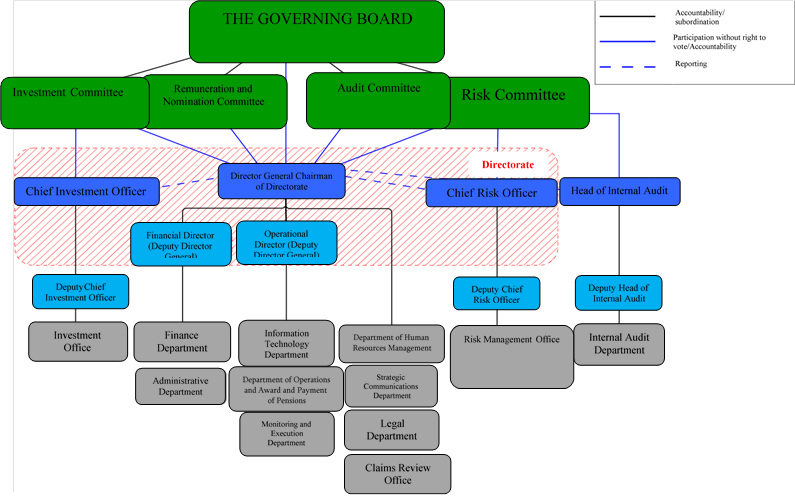
Document comments